Course
Medevac Flight Operations
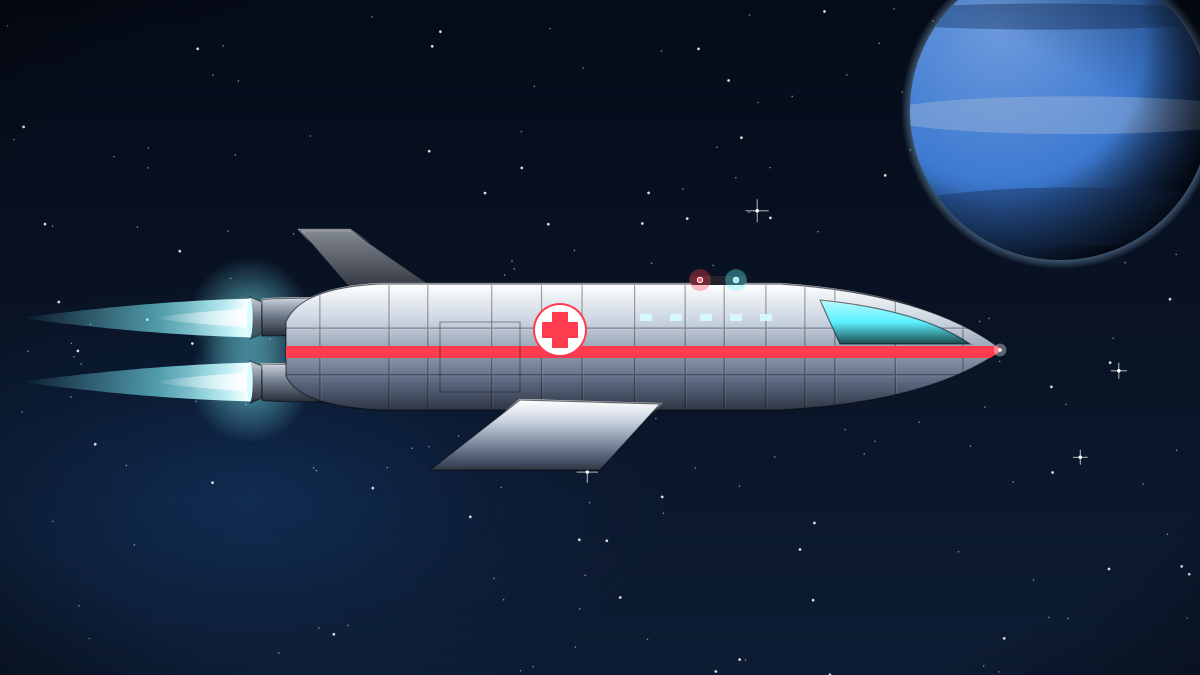
When a mining rig depressurises or a passenger falls ill halfway to Mars, the call goes to a Seraph crew. Medevac Flight Operations prepares experienced pilots to fly the Seraph Medevac, Halcyon's 74-metre rescue ship, and earn the Medevac Operations Endorsement that every rescue operator requires.
The Seraph is fast, at 780 km/s, and runs on antimatter-catalysed fusion microcapsules, but speed is only half the job. Its two pilots fly with a medical crew of seven and up to 12 patients aboard, and every manoeuvre must be balanced against what an injured body can tolerate. The 11-week syllabus teaches patient-safe acceleration limits, rapid intercepts of drifting or damaged craft, docking to a vessel that is still spinning, and the communication habits that keep pilots and physicians working as one team.
Training is based at the Olympus Ring above Mars, with a detachment at Shackleton Base on Luna. Students complete 130 simulator hours, including mass-casualty scenarios run jointly with trauma teams, and 75 flight hours in the Seraph. The final week is a live standby rotation: you will be on call alongside a working rescue crew and may fly genuine missions under instructor supervision.
Cohorts are capped at eight pilots with three instructors, one of them always a flight physician. Tuition is 124,000 credits, and several medical trusts sponsor seats for pilots willing to commit to two years of rescue service. You need a Commercial Pilot Licence (Orbital), 500 hours as pilot in command and an enhanced aeromedical certificate. The next intake starts on 3 November 2187.
Our first-time pass rate is 87 per cent. Graduates hold the Medevac Operations Endorsement and fly for rescue services from Luna to Ceres. Many describe it as the most meaningful flying they will ever do.