Course
Deep Explorer Command
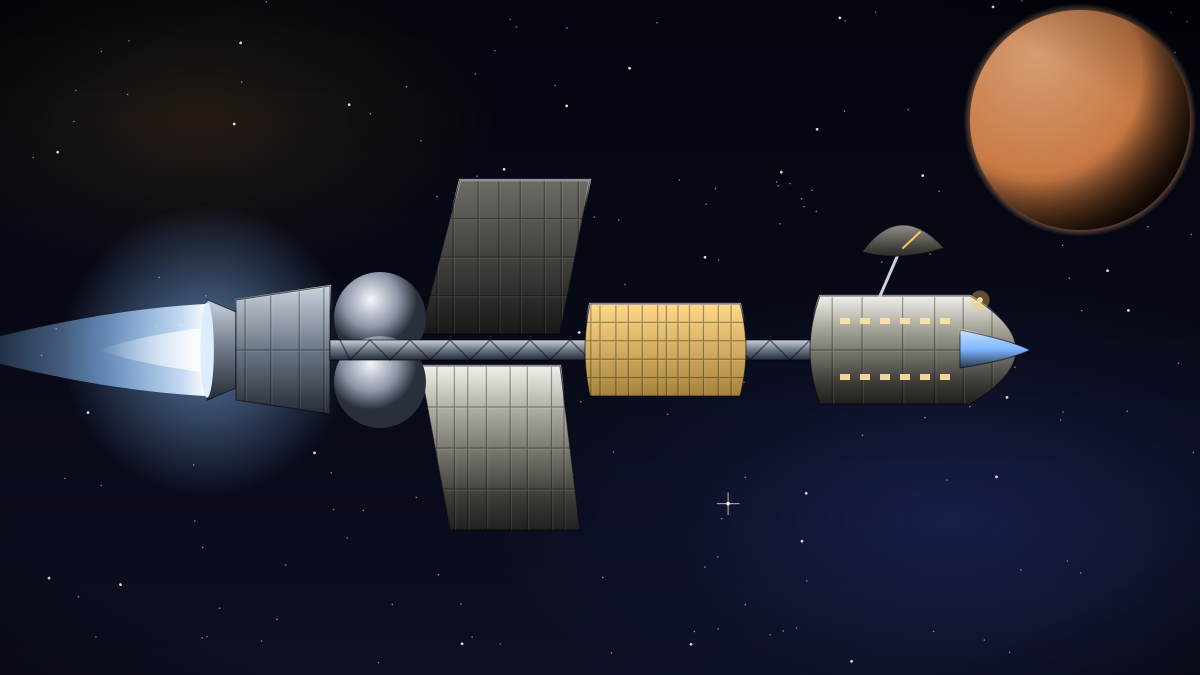
The Odyssey Deep Explorer can range 1,800 AU on helium-3 fusion pellets, sipping just 0.85 tonnes per 100 AU, and it routinely spends years beyond Saturn with a crew of 18. Its commander is the final authority on everything from navigation to medical triage, often months from the nearest port. Deep Explorer Command is our longest and most expensive course, and it prepares pilots for exactly that responsibility.
The 30-week programme combines advanced flying with expedition leadership. Technical modules cover deep-space navigation without beacons, long-coast reactor management, top-speed transits at 920 km/s, and repair improvisation on a 196-metre ship with 1,200 tonnes of stores. Equally important are the human modules: crew psychology on multi-year voyages, conflict resolution, isolation fatigue and making irreversible decisions with incomplete information.
Candidates complete 240 simulator hours, including a continuous 21-day isolation simulation in our Titan training annex, and 210 flight hours aboard Odyssey vessels operated by expedition partners. The final assessment is a deployment as deputy commander on a real outer-system leg under the supervision of a training commander.
Each cohort of eight candidates works with four training commanders, matching the Odyssey's four-pilot flight deck. Tuition is 285,000 credits, and the course is nearly always waitlisted because places are largely sponsored by exploration companies and cartographic societies. You need a Commercial Pilot Licence (Orbital), at least one heavy type rating, 2,500 hours of multi-crew time and a psychological suitability review. The next intake starts on 16 March 2188.
The first-time pass rate is 81 per cent. Graduates earn the Deep-Space Command Endorsement and go on to lead survey expeditions to Uranus, Neptune and Triton.